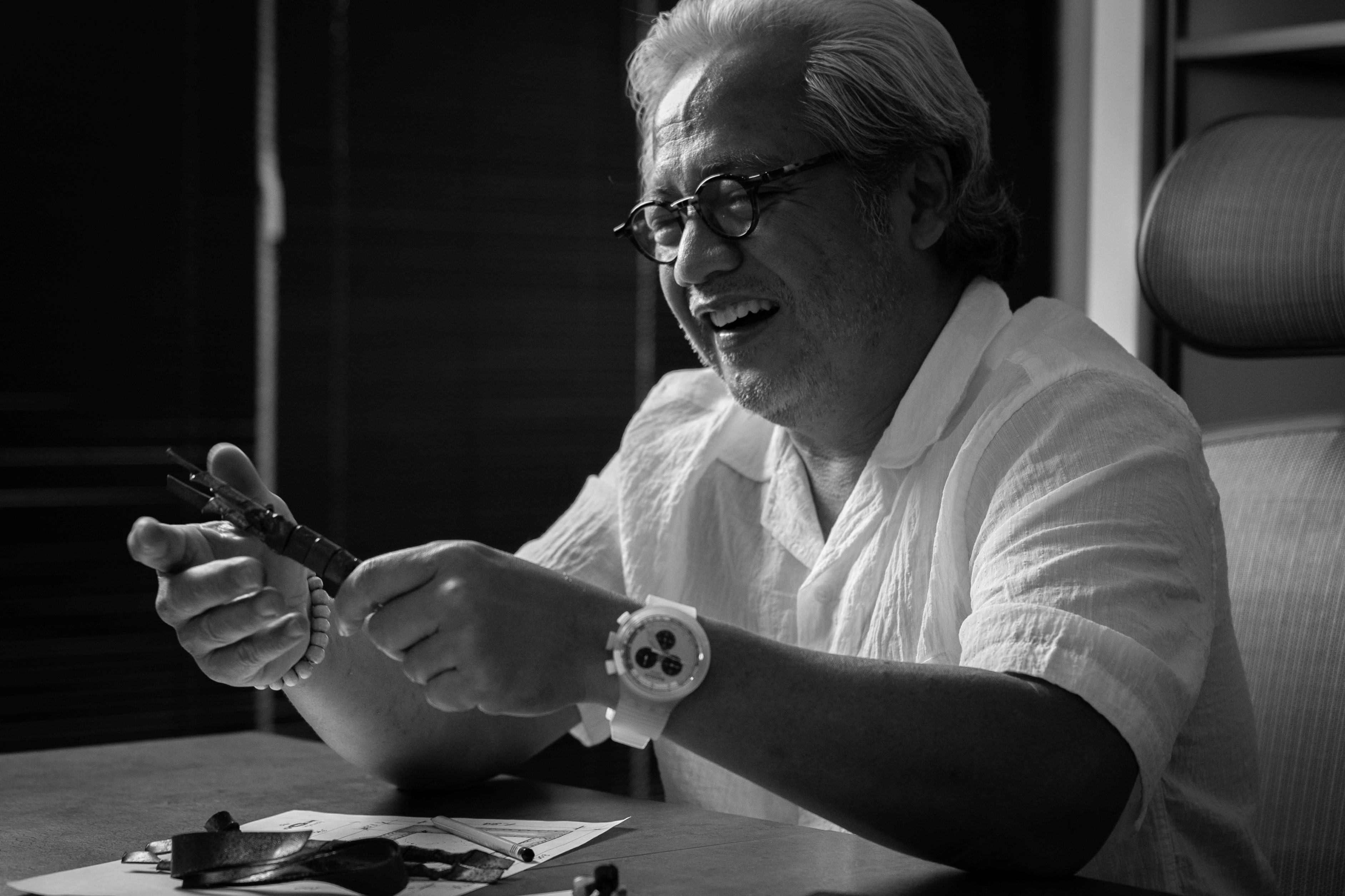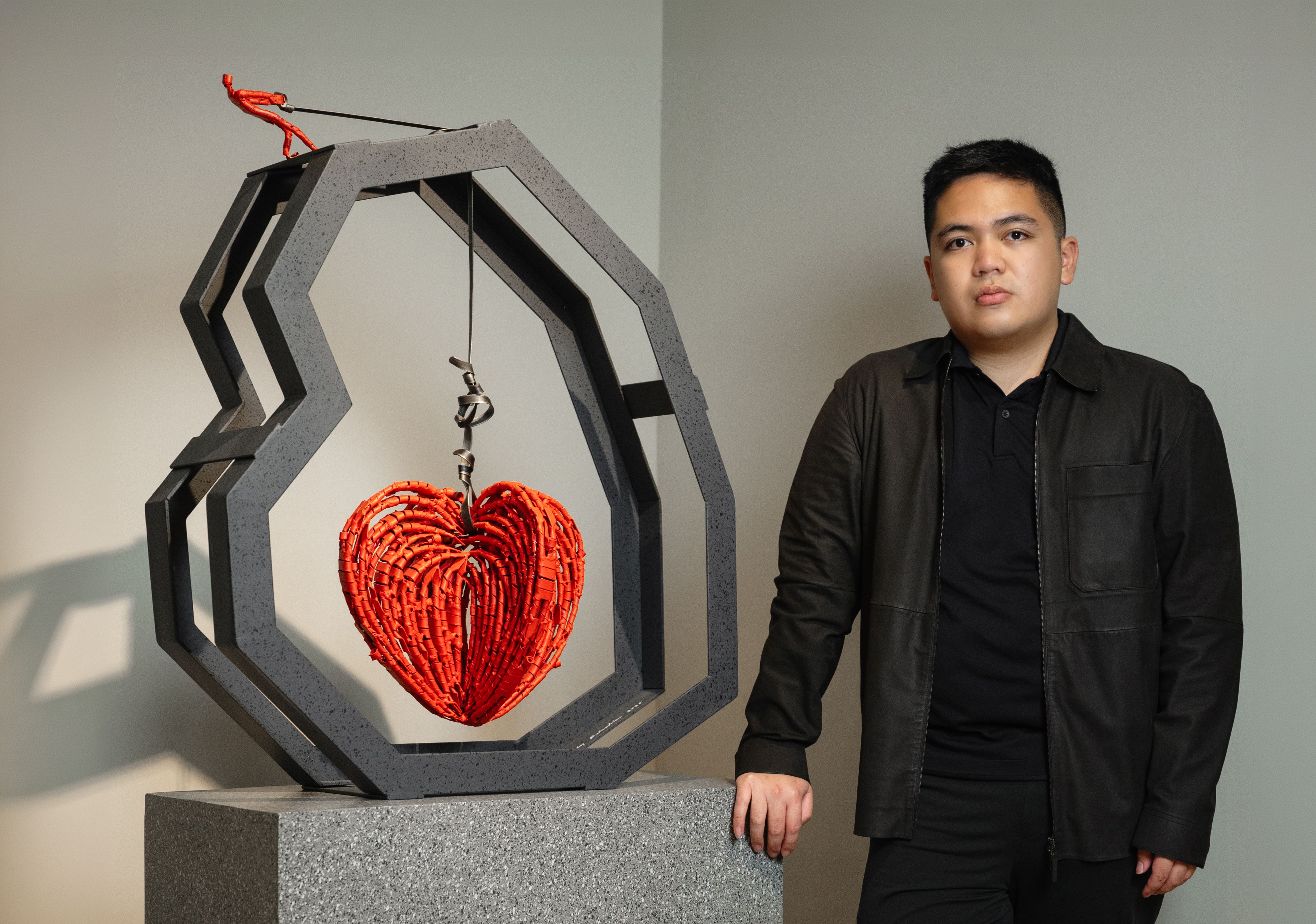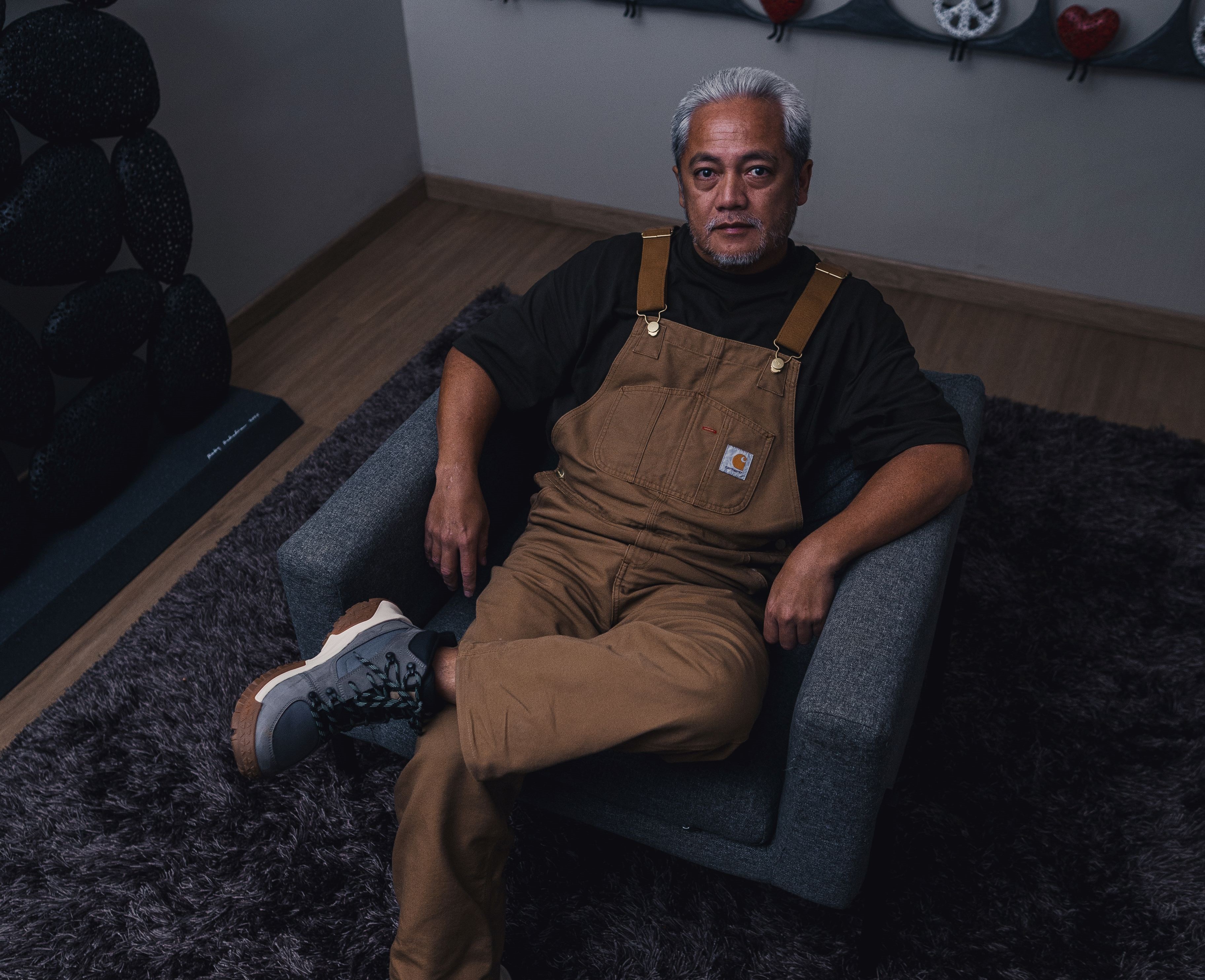
In a contemporary art landscape increasingly defined by digital experimentation and conceptual abstraction, the practice of Redy Rahadian occupies a quieter and more elemental territory. For more than two decades, the Indonesian sculptor has worked at the intersection of engineering and intuition, transforming industrial steel into sculptures of remarkable structural complexity and emotional precision. His work has entered private and institutional collections across Asia and Europe, and has been presented at international auction houses including Christie's and Sotheby's, situating him among the most internationally recognised sculptors of his generation in Southeast Asia.
Born on 17 May 1973 in Cianjur, West Java, Rahadian came to sculpture by an unusual route. He trained as a mechanical engineer at the Institut Saint Joseph in Brussels, Belgium, where he developed an intimate technical understanding of metal as both substance and structure. In 1997, he committed fully to artistic practice, carrying the disciplines of engineering, tolerance, load, joinery, structural integrity, into the language of fine art.
That dual inheritance has shaped every aspect of his subsequent work. Where many sculptors approach steel as a material to be subdued, Rahadian treats it as a counterpart in dialogue. His engineering background informs an exceptional structural intelligence; his artistic vision releases the medium from its purely industrial associations. The resulting practice occupies a rare and self-defined territory: technically rigorous, conceptually mature, and unmistakably his own. Rahadian's most distinctive contribution to contemporary sculpture lies in his fully handmade, mould-free welding technique. The majority of large-scale metal sculptors rely on moulds, casts, or pre-fabricated armatures to construct their forms. Rahadian does not.
Each work is built free-hand, weld by weld, comprising thousands of individually cut, bent, and joined steel components. There is no template, no prototype, no replicable process. The artist composes directly in three dimensions, allowing form to emerge through the cumulative discipline of countless hands-on decisions. The approach is uncommon, materially demanding, and entirely irreplicable. It is also the source of the visual language that defines his oeuvre: surfaces alive with rhythm and density, forms that hold both monumentality and granular intimacy, sculptures that bear the literal record of the artist's hand at every joint and seam. Redy Rahadian builds sculpture the way an engineer builds structure: by hand, joint by joint, without moulds. This method, sustained over more than twenty-five years, is what separates his work from the cast and fabricated sculpture that dominates the metal medium. Every form he produces exists once, shaped directly in steel by the artist himself.
Rahadian's technique is inseparable from his formation. He trained in mechanical engineering at Institut Saint Joseph in Brussels before beginning his artistic practice in 1997. Engineering gave him what art school rarely does: a working knowledge of load, tension and tolerance. He understands how metal behaves under heat and stress, and he composes with that knowledge. His sculptures stand not because they are solid, but because they are resolved as structures. The core of the practice is direct metalwork. Rahadian cuts, bends and welds solid steel free-hand, refusing the mould-based processes most metal sculptors rely on. Nothing is cast, nothing is repeated from a template. Each joint, seam and surface is made and finished by hand. The discipline is demanding, and it is the source of the work's signature quality: compositions in rigid industrial steel that read as fluid, organic and alive. The weld itself is not concealed as a manufacturing trace. It is the drawing line of the work.
Rahadian works across steel, iron, stainless steel, aluminium and copper, and treats each as a distinct vocabulary. His approach begins with the character of the material: its weight, its resistance, its response to fire. Mild steel carries his figurative work; stainless steel brings reflectivity and permanence; painted finishes, as in the recent Dragon Series and Circle of Life series, add a chromatic register to the structural one. Colour in his practice is never decoration. It carries the symbolic argument of the work.
His most recognisable device is modular: small welded human figures, assembled in their hundreds into larger forms. In the Circle of Life series they form a continuous ring; in Lakukan yang Terbaik (The Best You Can Be, 2025) they stack into a rising tower of spheres. The technique is the meaning. Each figure is an individual effort, imperfect and hand-made, and the sculpture only stands because the figures bear one another's weight. Structure and philosophy are the same gesture.
The method holds from collector scale to monumental commission. Terbang Tinggi (2025), a painted steel work of 700 x 400 x 120 cm installed at The Apurva Kempinski Bali, applies the same free-hand construction at architectural size, where engineering competence becomes a condition of the art itself. This range, from an 85 cm tabletop work to a seven-metre public commission built with one technique and one hand, defines Rahadian's position in Indonesian contemporary sculpture.
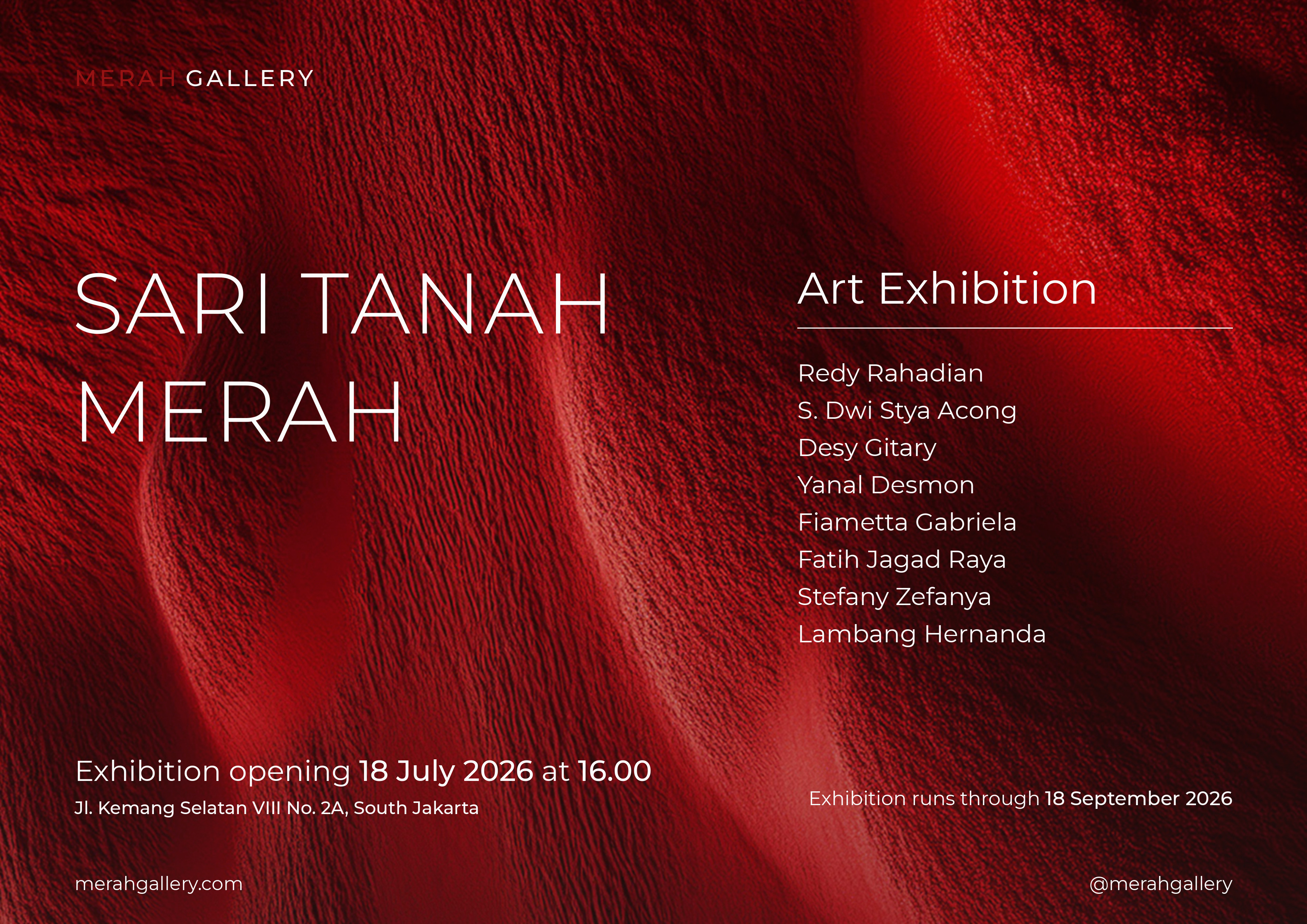
Merah Gallery Jakarta, Jl. Kemang Selatan VIII No.2A, Bangka, South Jakarta 12730.
Merah Gallery Bali, Jl. Subak Belaki No.60A, Sukawati, Gianyar 80582.
Enquiries regarding exhibitions, representation, and galleryprogramming may be directed to the team.
Email info@merahgallery.com
WhatsApp +62 8111 0100 917
Website www.merahgallery.com
Instagram @merahgallery

P : +62 8111 0100 917 (Whatsapp)
A : Jl. Kemang Selatan VIII No.2A,
South Jakarta 12730.
A : Jl. Subak Belaki No.60A, Sukawati,
Gianyar, Bali 80582.
H : Monday to Sunday, 10am to 5pm
Download Gallery Profile.png)